

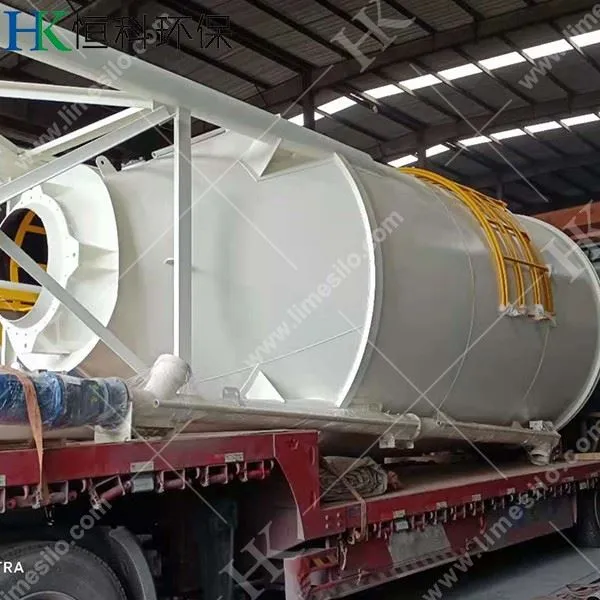
Selecting the appropriate size of bulk storage silos for lime is a crucial decision that can significantly impact the efficiency, cost - effectiveness, and overall success of your lime storage operations. As a supplier of Bulk Storage Silos For Lime, I understand the complexities involved in this process and am here to guide you through it.
Understanding Lime Storage Requirements
Before delving into the size selection, it's important to understand the unique characteristics of lime. Lime, whether in the form of limestone or lime powder, has specific storage requirements. Lime is a hygroscopic material, which means it can absorb moisture from the air. This can lead to caking and other issues if not stored properly. Therefore, the silo should provide a sealed environment to prevent moisture ingress.
The type of lime also matters. Limestone, which is a coarser material, may require different silo designs compared to lime powder. For more information on limestone storage, you can visit our Limestone Storage Silo page. Lime powder, on the other hand, is finer and more prone to dusting, so special attention should be paid to the silo's dust control and discharge systems. Check out our Lime Powder Silo for detailed information.
Factors Influencing Silo Size Selection
Production and Consumption Rates
One of the primary factors in determining the silo size is the production and consumption rates of lime. If your production process generates a large amount of lime on a daily basis, you'll need a larger silo to store it. Similarly, if your consumption rate is high, the silo should be sized to ensure a continuous supply of lime without frequent refilling.
For example, if your factory produces 100 tons of lime per day and your consumption rate is 80 tons per day, you need to account for the excess production. A silo that can store at least a few days' worth of excess lime would be ideal. This allows for some flexibility in case of production fluctuations or supply disruptions.
Space Availability
The physical space available at your facility is another important consideration. You may have a large demand for lime storage, but if you don't have enough space to install a large - scale silo, you'll need to find a more space - efficient solution. Some silos are designed to be tall and narrow, which can be a good option when floor space is limited.
Future Expansion Plans
It's also essential to consider your future expansion plans. If you anticipate an increase in lime production or consumption in the coming years, it may be wise to invest in a larger silo from the start. This can save you the cost and hassle of having to replace or expand the silo later.
Calculating the Ideal Silo Size
Volume Calculation
To calculate the volume of the silo needed, you first need to determine the amount of lime you need to store. This can be based on your daily production and consumption rates, as well as the desired storage duration.
The volume of a cylindrical silo can be calculated using the formula (V=\pi r^{2}h), where (r) is the radius of the silo and (h) is the height. For a cone - bottomed silo, you also need to consider the volume of the cone, which is given by (V_{cone}=\frac{1}{3}\pi r^{2}h_{cone}), where (h_{cone}) is the height of the cone.
For example, if you need to store 500 tons of lime powder and the density of lime powder is approximately 1.2 tons per cubic meter, you'll need a silo with a volume of (\frac{500}{1.2}\approx417) cubic meters.
Accounting for Freeboard
When calculating the silo size, it's important to account for freeboard. Freeboard is the empty space at the top of the silo, which is necessary to prevent overfilling and to accommodate any expansion of the material due to aeration or other factors. A general rule of thumb is to leave about 10 - 15% of the silo's total height as freeboard.
Selecting the Right Silo Design
Material of Construction
The choice of material for the silo is also important. Common materials include carbon steel, stainless steel, and concrete. Carbon steel is a cost - effective option but may require regular maintenance to prevent corrosion. Stainless steel is more corrosion - resistant but is also more expensive. Concrete silos are durable and can be a good option for large - scale storage, but they are more difficult and costly to install.
Discharge System
The discharge system of the silo is crucial for efficient lime handling. There are several types of discharge systems available, such as screw conveyors, pneumatic conveyors, and gravity - flow systems. The choice of discharge system depends on the type of lime, the desired flow rate, and the layout of your facility. For lime powder, a well - designed dust - control system should also be integrated into the discharge system. You can find more details about our Lime Powder Silo Powder Tanks and their discharge systems on our website.
Benefits of Choosing the Right Silo Size
Cost Savings
A properly sized silo can lead to significant cost savings. If the silo is too small, you may need to refill it more frequently, which can increase transportation and labor costs. On the other hand, an oversized silo can result in unnecessary capital expenditure and higher maintenance costs.
Operational Efficiency
The right - sized silo ensures a smooth and continuous supply of lime to your production process. This reduces downtime and improves overall operational efficiency. It also allows for better inventory management, as you can accurately monitor the amount of lime in storage.
Product Quality
Proper storage in a well - sized silo helps maintain the quality of the lime. By preventing moisture ingress and minimizing dusting, the lime remains in good condition, which is essential for its performance in downstream processes.

Conclusion
Choosing the right size of bulk storage silos for lime is a multi - faceted process that requires careful consideration of various factors. From production and consumption rates to space availability and future expansion plans, every detail matters. As a supplier of Bulk Storage Silos For Lime, we have the expertise and experience to help you make the best decision for your specific needs.
If you're interested in purchasing bulk storage silos for lime or need more information, we encourage you to reach out to us. Our team of experts is ready to assist you in selecting the perfect silo size and design for your operations.
References
- Smith, J. (2018). "Best Practices in Lime Storage". Industrial Minerals Journal.
- Johnson, R. (2019). "Silo Design and Selection for Powdered Materials". Chemical Engineering Review.
- Thompson, A. (2020). "Calculating Storage Requirements for Hygroscopic Materials". Storage Solutions Magazine.